

Introduction
Lipstick tubes are one of the most technically complex types of primary cosmetic packaging. They consist of multiple functional components made from different materials, and every detail—from fit tolerance to lubricant application—can affect the final user experience. At Aochuang Pack, we’ve put together a foundational guide to help buyers and sourcing agents better understand lipstick packaging before placing an order.
🔧 Product Definition: What is a Lipstick Tube?
Unlike many standard plastic containers, a lipstick tube is a precise mechanical structure made up of various components—each with a distinct function. Based on the product formulation, tubes can be used for volatile or non-volatile formulas, requiring airtight or semi-airtight designs.
Lipstick filling is typically completed using automatic machines (top-fill, bottom-fill, or direct-fill). Any issues with internal design—such as poor tolerance matching or improper lubrication—can cause the filling machine to jam or affect product functionality.
Pro Tip: A lipstick tube is more than just a pretty shell—it's a precision tool. Pay close attention to its internal mechanical design.
🏭 Manufacturing Materials & Craft
1. Materials
Plastic: Common resins include PC, ABS, PMMA, PCTA, PP, ABS+SAN, SAN
Aluminum: Alloy grades like 1070, 5657 are often used
Others: Zinc alloy, PU leather, and other materials are sometimes added to elevate texture and brand tone
2. Processing Techniques
Plastic components: Produced via injection molding
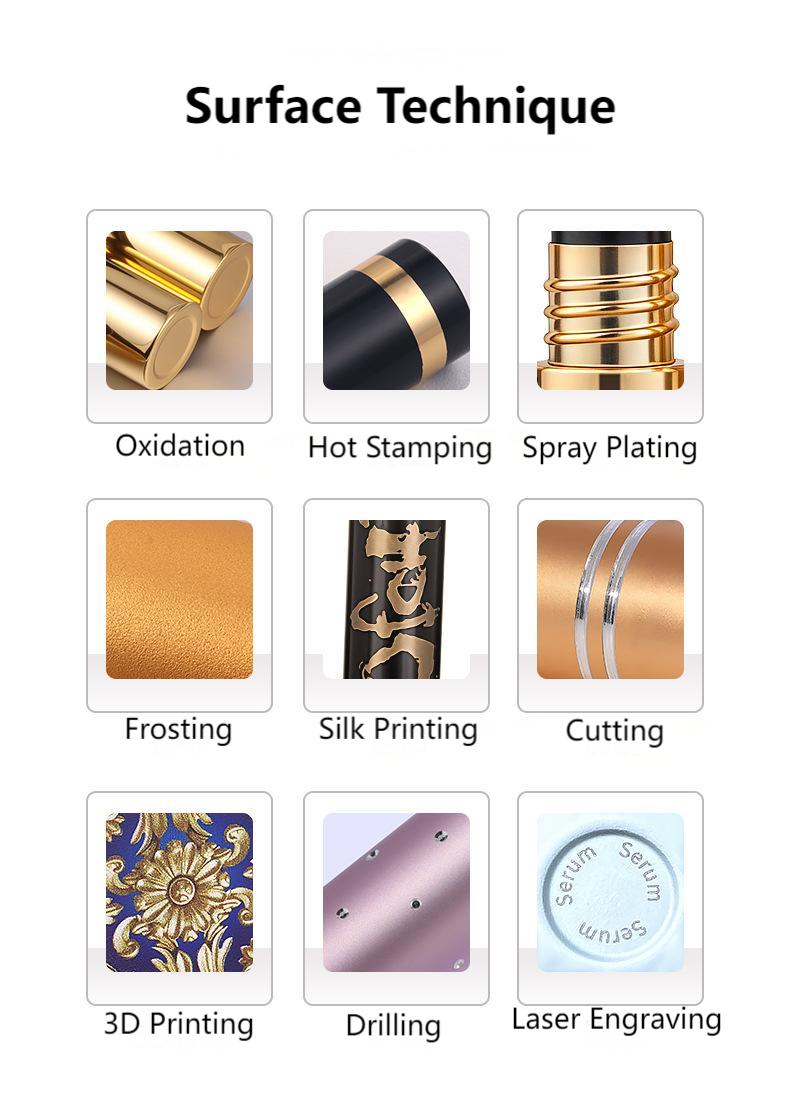
Surface finishing: Includes spraying, vacuum metallizing, electroplating, laser engraving, insert molding
Aluminum finishing: Anodizing or electroplating
Decoration: Silkscreen, hot stamping, pad printing, heat transfer, or water transfer printing for branding
🧩 Product Structure Breakdown
Core Components:
Cap: ABS, acrylic, or anodized aluminum
Base: Typically plastic (ABS or acrylic), sometimes metal; may include added iron weight for premium feel (though adhesive failures can be a risk)
Inner Mechanism (Center Core): Often aluminum or injection-molded plastic; this is the “engine” of the tube
🌀 The Cup-Fork-Spiral System
This system is the heart of the lipstick tube and consists of:
Cup: Holds the lipstick bullet directly
Fork: Guides vertical movement of the cup
Spiral: Enables rotational lifting of the cup via the twist mechanism
Known as the “quick spiral,” this structure often uses a long pitch thread, so one twist causes the bullet to rise significantly. It’s a sophisticated mechanism and more complex than a pump core. Standardization of this structure is crucial for proper assembly and compatibility with filling machines.
Some suppliers offer “oil-free spiral” systems, but adoption is still limited due to performance risks.
📌 Buyer’s Checklist: What to Watch for When Sourcing Lipstick Tubes
Do not choose suppliers just based on name-dropping big brands like “L’Oréal used this.” Your filling machine, formulation, and tolerances are different. Focus on technical drawings, especially for the cup/fork/spiral unit.
Ask for verified spiral system drawings. If a supplier can’t provide them, it’s a red flag.
Assess these technical factors:
Filling machine compatibility
Torque and smoothness of twisting
Airtightness
Tolerance matching between metal/plastic
Vibration resistance during transport
Material compatibility and safety (especially lubricants)
Real fill volume vs. claimed specs
Aluminum Lipstick Tube Safety Note:
Sharp-edge risks from aluminum cutting must be managed
Request blade safety testing per 16 CFR 1500.49 and use adhesive insulation tape per MIL-I-23594B for evaluation
✅ Conclusion
Lipstick packaging may look simple on the outside, but inside it is an intricate, functional system. At Aochuang Pack, we offer full support—from custom mechanism design to strict tolerance control—ensuring your lipstick tubes not only look good but work flawlessly with your filling and formulation needs. Whether you're sourcing for a luxury line or a mass-market brand, understanding these fundamentals helps you make smarter purchasing decisions.
